For a sovereign and energy-efficient digital future,
modularity at the system level is not optional — it is a key requirement.
For a sovereign and energy-efficient digital future, modularity at the system level is not optional — it is a key requirement.
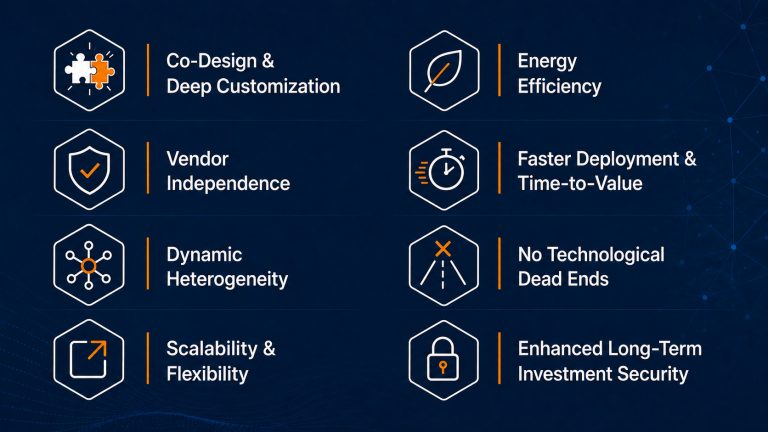
Modern HPC, AI, and Quantum computation demands heterogeneity. Our architecture and orchestration software ensure adaptability and operate as a unified system, eliminating technological dead ends, preventing vendor lock-in, and enabling controlled technological evolution with long-term investment security.
With ParTec’s patented dynamic Modular System Architecture (dMSA) we create a unique structural nexus between diverse compute elements — CPUs, GPUs, accelerators, storage, memory, and future quantum technologies — composing them into one adaptable, energy-aware system.
dMSA underpins Europe’s most powerful and sustainable supercomputers.
Modularity as the Architectural Foundation of Sovereign Compute
The Backbone of Europe’s first Exascale System and other leading Supercomputers
The underlying system infrastructure determines long-term capability, investment security, technological independence, and innovation potential. A well-designed architecture enables systems to evolve over time rather than reaching structural limits.
Architecture and orchestration ultimately determine whether infrastructure can continuously adapt to new requirements.
Only scalable, modular architectures enable true sovereignty. The architectural choices made today determine whether infrastructure remains adaptable — or becomes obsolete.
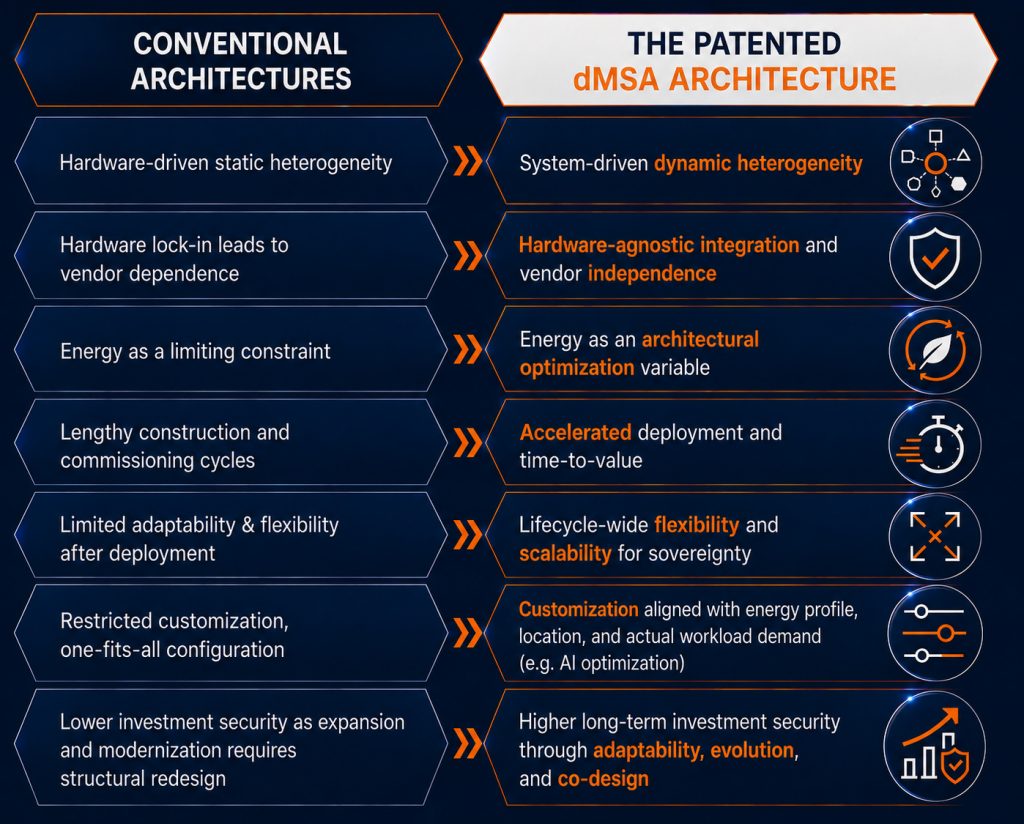
Conventional supercomputers are built as fixed systems in a world where workloads are nowadays highly dynamic.
The consequences are measurable. This rigidity leads to
Computing environments now need to accommodate a wide swathe of workloads, which include:
Fixed-node architectures force heterogeneous workloads onto homogeneous hardware, making compromises which impact delivered performance and efficiency. This constraint is structural.
ParTec’s dynamic Modular System Architecture (dMSA)
ParTec’s patented dynamic Modular System Architecture (dMSA) enables scalable, hardware-agnostic, and energy-efficient heterogeneous computing for HPC, AI and QC — by design.
Based on extensive research and many years of expertise, ParTec’s dMSA forms the structural backbone of Europe’s leading high-performance systems.
The dMSA has been deployed in leading European supercomputers and serves as the architectural blueprint for European Exascale and post-Exascale systems.
The architecture anticipates technological evolution.
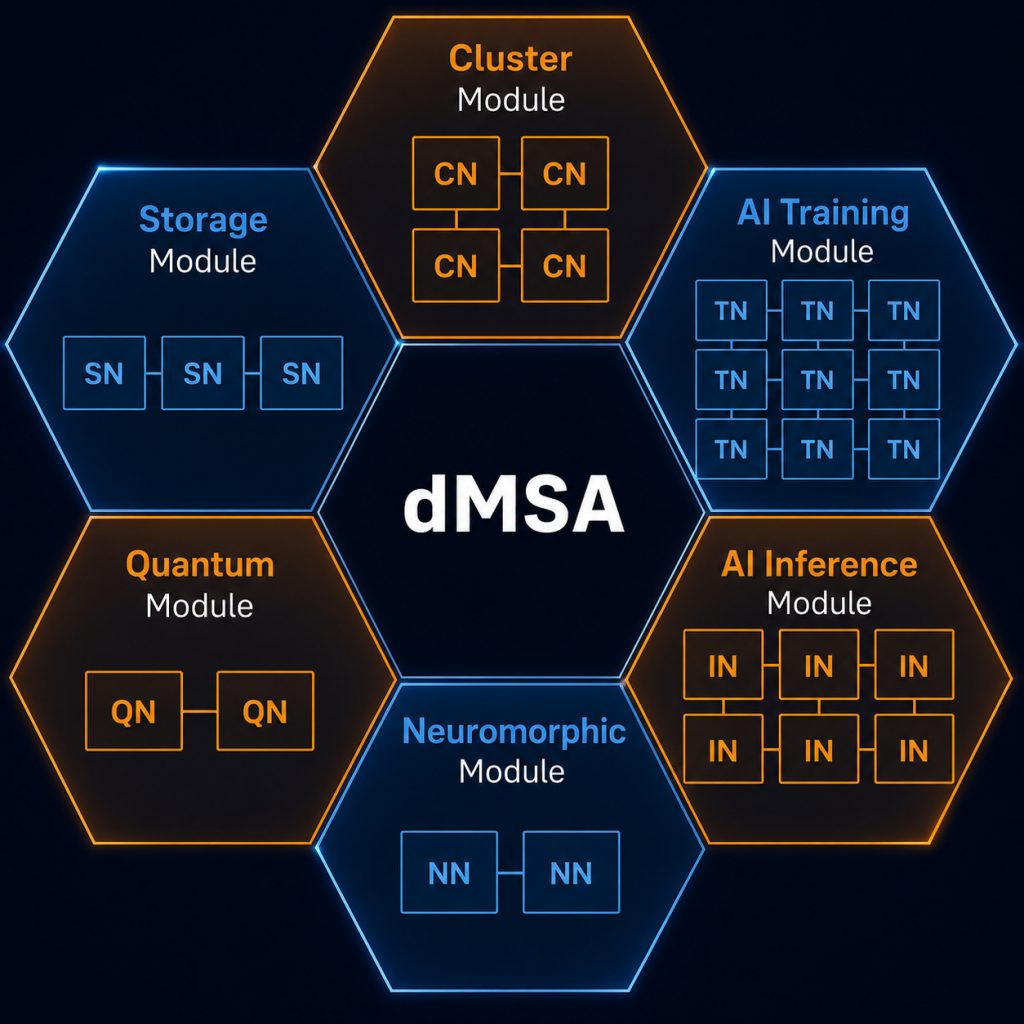
Quantum processors, storage, memory, and emerging compute paradigms such as neuromorphic computing can be integrated as additional modules and scaled independently— without dismantling the system foundation. There are no technological dead ends – only controlled evolution, flexibility, and scalability exactly as the demands require.
One of ParTec’s core strengths is co-design and deep customization.
Through our modular architecture, systems are precisely aligned with specific workload characteristics, energy profiles, and long-term strategic objectives. Infrastructure is not predefined. It is engineered to match current demand — and structured to evolve with future requirements. Hence, our customers can benefit from innovations even long after the deployment of their systems.
The dMSA replaces node replication with tightly coupled compute and storage modules.
Each module is purpose-built:
Applications are no longer constrained by fixed ratios of different hardware entities. Runtime systems dynamically compose execution environments across modules — matching architecture to workload characteristics in real time. Composition and decomposition occur during runtime. Different execution phases operate on different architectural configurations.
The system adapts structurally.
Highly parallel components run on dense accelerator modules. Serial or control-intensive phases run on high-performance CPUs. Efficiency is achieved by design.
Mixed HPC–AI workflows benefit particularly from this structural flexibility.
The Backbone for Sovereign Modular Compute
If hardware is the body of a supercomputer,
architecture is its structural design —
and orchestration is its nervous system.
ParaStation Modulo Software Suite functions as the backbone of the supercomputer,— the governing layer that coordinates CPUs, GPUs, accelerators, storage, and emerging technologies into one coherent operational fabric.
Without this layer, infrastructure remains fragmented and inefficient.
With it, infrastructure becomes not only adaptive, governable, and resilient but also highly flexible and scalable, ready to evolve with true workload demands.
The ParaStation Modulo Software Suite eliminates structural vendor lock-in through hardware-agnostic integration and modular orchestration. Emerging technologies integrate without redesigning the system foundation.
Control over long-term compute capability remains with the operator — not the vendor.
Infrastructure decisions define many years of capability and innovation.
The ParaStation Modulo Software Suite enables controlled system evolution, providing high protection of investments from technological obsolescence. Modular integration avoids disruptive redesign and enables expansion without architectural replacement.
Modern environments combine HPC-style simulation, AI, analytics, and emerging paradigms within one infrastructure.
The ParaStation Modulo Software Suite dynamically composes heterogeneous modules into unified execution environments, aligning resources with workload requirements in real time across the system fabric.
Heterogeneity becomes scalable, performance-optimized, and economically efficient.
Through system-level workload governance and architectural alignment, the ParaStation Modulo Software Suite enables performance-per-watt optimization across heterogeneous modules.
The ParaStation Modulo Software Suite is built for production environments at the highest scale. Integrated monitoring, validation, lifecycle management, and proactive support ensure resilience and predictability.
The ParaStation Modulo Software Suite serves as the orchestration backbone of Europe’s first Exascale system — and the most energy-efficient Exascale system worldwide.
The ParaStation Modulo Software Suite is a comprehensive system management and orchestration framework consisting of four tightly integrated components:
Hardware-agnostic provisioning and administration framework simplifying deployment and lifecycle management. An image-based node management approach allows for rolling updates and minimal downtime. It integrates seamlessly with tools for efficient configuration management.
Scalability & Cluster Management
Managing large clusters with heterogeneous components and minimizing downtime is complex. System admins need reliable ways to provision, update, customize thousands of nodes at scale.
Automated integrity checks with non-destructive testing, reporting, and a self-recovering “checkbot” that brings offline nodes back online whenever possible.
Ensuring System Health
Component failures, system errors and misconfigurations can compromise productivity and cause significant delays in job execution, especially in large-scale, modular systems.
Thanks to seamless integration with ClusterTools and HealthChecker, TicketSuite centralizes all issue tracking and escalation in one interface dedicated to the system at the customer’s site.
Efficient Issue Tracking
Managing and resolving system-level issues across multiple modules and nodes can be overwhelming, particularly in distributed or hybrid environments.
A Message-Passing Interface (MPI) runtime library with optimized low-level, point-to-point communication and support for the PMIx standard, enables high performance for malleable workloads and evolving workflows.
Communication For Dynamic Workloads
Low-latency, high-bandwidth communication across modular, heterogeneous systems is essential for Exascale computing but is challenging in federated networks and for highly dynamic workloads.

To provide you with an optimal experience, we use technologies such as cookies to store and/or access device information. If you consent to these technologies, we may process data such as browsing behavior or unique IDs on this website. If you do not give or withdraw your consent, certain features and functions may be impaired.