ParTec technology powers world-leading supercomputers — including TOP500 systems JUPITER (#4) and Leonardo (#10) — and drives global energy-efficiency leadership with the three-time Green500 winner JEDI.
ParTec is a key technological provider for several of Europe’s most powerful and most energy-efficient supercomputers. In the most recent TOP500 list of the worldwide fastest systems (Nov25), ParTec has participated substantially in two of the current top 10; #4th JUPITER and 10th Leonardo. Systems leveraging ParTec’s technology consistently achieve top rankings on the global Green500 list for energy-efficient high-performance computing, as shown by the three-time global winner JEDI (June 2024, November 2024, and June 2025).
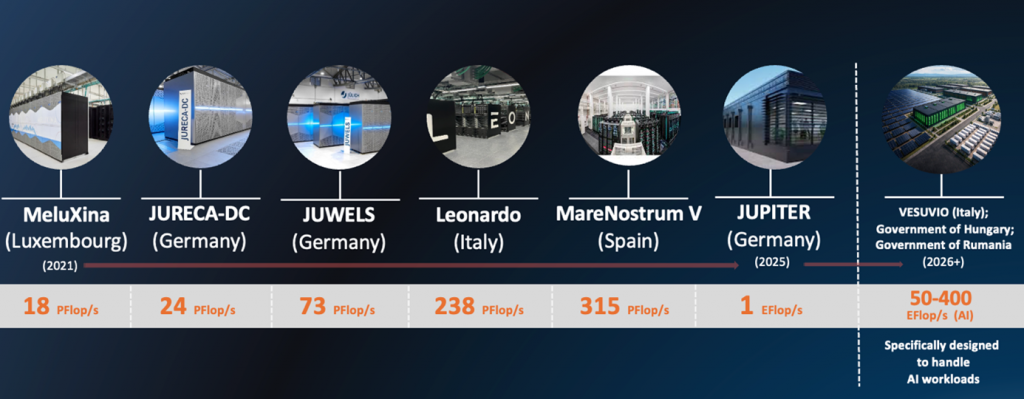
Copyright: Meluxina, LuxProvide; Forschungszentrum Jülich (JSC); CINECA, Barcelona Supercomputing Center
Research Centre Jülich, Germany
Copyright: Forschungszentrum Jülich, Text ParTec AG
JUPITER relies on ParTec’s patented dynamic Modular System Architecture (dMSA) and the JUPITER Management Stack (JMS) as its core technical foundation. The JMS is built upon ParTec’s ParaStation Modulo Software Suite, highlighting the company’s leading role in developing and providing the key technologies that make Exascale performance and high energy efficiency possible.
For more information about our technology, please click here.
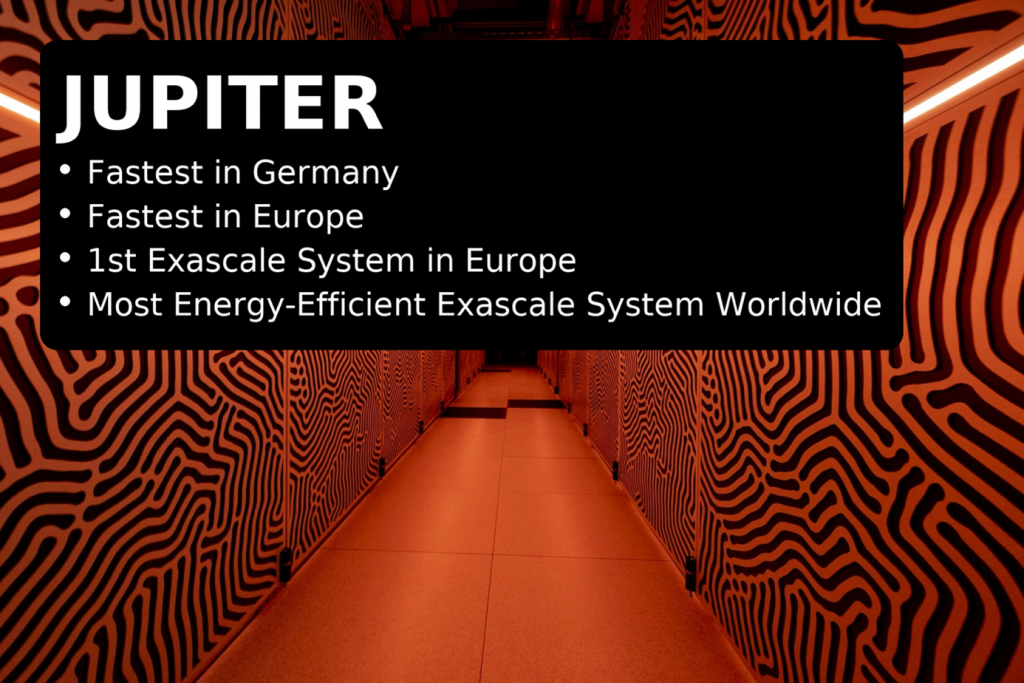
JUPITER “Joint Undertaking Pioneer for Innovative and Transformative Exascale Research”, at Research Centre Jülich is the first European supercomputer in the exascale class, delivering a computing power of more than one quintillion floating-point operations per second. JUPITER achieves one double precision (64 bit) ExaFLOP/s with typically required for scientific simulations.
The system is built by a supercomputer consortium of ParTec and Eviden and was procured by EuroHPC JU in collaboration with the Jülich Supercomputing Centre (JSC).
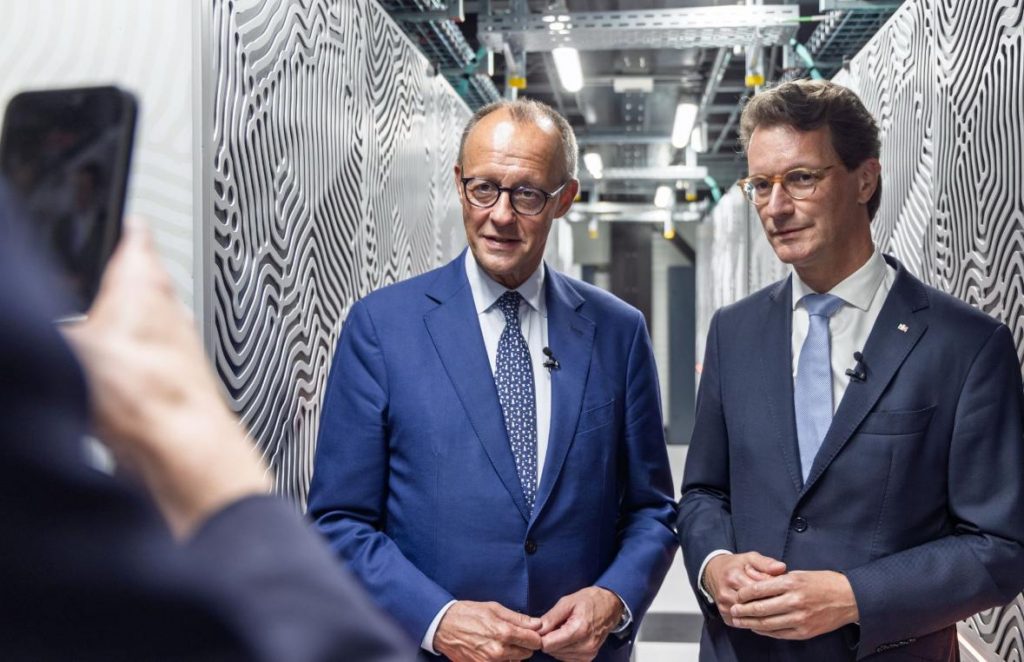
German Chancellor Friedrich Merz and Prime Minister of North Rhine-Westphalia Hendrik Wüst in front of JUPITER.
Copyright: Research Centre Jülich
JUPITER also received international recognition with the HPCwire Readers’ Choice Award in the “Top Supercomputing Achievement” category, proving that Europe is capable of competing on equal terms with global technology centers like the US and Japan.
The fact that the Booster part was designed and installed in less than two years after the 2023 contract was signed highlights ParTec’s and all the project partners’ ability to deliver complex, highly scalable computing architectures within exceptionally short timeframes.
All partners made significant contributions to the construction of this modular data center.
At lower numerical precision – such as in AI model training – JUPITER achieves a theoretical performance of over 40 ExaFLOP/s (8-bit floating-point calculations). This makes JUPITER one of the fastest AI computers in the world, with exceptional large-scale AI training performance due to ist high-performance interconnect network.
JUPITER is already delivering early scientific successes: more than 100 research projects are running on the system, including the simulation of a universal 50-qubit quantum computer and a global Earth system model at 1 km resolution, previously considered computationally unattainable. These early results already demonstrate the new possibilities that Exascale systems open up for research and industry. The weather model has won the 2025 Gordon Bell award at SC25 in St. Louis.
The realization of JUPITER builds on more than 20 years of technological and trusted cooperation between ParTec and Research Centre Jülich. Systems such as JUROPA, JURECA, JUWELS, and the JUWELS Booster laid the foundations for the modular architecture now implemented in JUPITER. JUPITER is the first European supercomputer to apply this modular technology at Exascale magnitude.
JUPITER is funded jointly by the EuroHPC Joint Undertaking (EuroHPC JU) with 50% and the German Federal Ministry of Research, Technology and Space (BMFTR) and the Ministry of Culture and Science of the State of North Rhine-Westphalia (MKW NRW) with 25% each The system is operated the Jülich Supercomputing Centre (JSC) at Forschungszentrum Jülich. It forms the core of a European strategy for strengthening technological sovereignty in high-performance computing and laying the foundation for future AI and QC innovations.

To provide you with an optimal experience, we use technologies such as cookies to store and/or access device information. If you consent to these technologies, we may process data such as browsing behavior or unique IDs on this website. If you do not give or withdraw your consent, certain features and functions may be impaired.